
Designing Scalable Donor Walls for Growing Organizations
When you're designing a donor wall for a growing organization, you're not just creating a list of names. You're building a recognition system that has to breathe and expand alongside your success. This means thinking about modular components and digital integrations from the very beginning, allowing you to seamlessly add new supporters as your fundraising takes off. The real secret is planning for tomorrow's growth, today.
Why Traditional Donor Walls Fail Growing Organizations
Picture this: a university foundation unveils a stunning donor wall, with names beautifully etched into massive glass panels. It's a huge success. So huge, in fact, that it’s completely full in just three years. This isn't a failure—it’s the sign of an incredible fundraising team. But now, it's an awkward and expensive problem that so many expanding organizations run into.
This scenario gets right to the heart of why static recognition displays just don't work long-term. Traditional methods, like fixed brass plaques or engraved panels, are built for a single moment. By their very nature, they are finite.
The Problem of Finite Space
For a thriving nonprofit, running out of space on a donor wall is a common growing pain. When a fixed display is full, the leadership team is left with a few tough choices:
Just stop adding names. This is a fast way to alienate new, generous supporters who rightly expect the same recognition as their peers.
Commission a second wall. This almost always looks like an afterthought, creating a visual disconnect and making the new display feel like a "B-list."
Tear down and replace the whole thing. This is an incredibly costly and wasteful option that can, understandably, upset the donors you originally honored.
Simply put, these static displays can't keep pace with a successful capital campaign or a robust annual giving program.
For a quick breakdown, here’s how a scalable approach stacks up against a traditional one.
Scalable vs Traditional Donor Walls at a Glance
Feature | Traditional Donor Wall | Scalable Donor Wall |
|---|---|---|
Flexibility | Static and finite; difficult and costly to update. | Modular and dynamic; easy and affordable to add names. |
Storytelling | A snapshot in time; cannot show ongoing impact. | A living story; can feature real-time updates and videos. |
Cost Over Time | High replacement or expansion costs. | Lower long-term costs; add-ons are part of the plan. |
Donor Engagement | Passive viewing only. | Interactive (digital) or easily updatable (modular). |
Space Usage | Requires large, fixed footprint from day one. | Can start small and grow, adapting to available space. |
Choosing a scalable wall is a strategic move that pays dividends as your organization flourishes.
The Inability to Tell an Evolving Story
Beyond the physical limitations, traditional walls fail to capture the living, breathing story of your mission. They're a snapshot, frozen in time. A static wall can’t show real-time campaign progress, share videos of your work in action, or highlight the powerful stories behind the gifts.
This is a huge missed opportunity to deepen the connection between donors and the cause they care about. When you’re making a significant investment like a donor wall, it's critical to consider the value of custom solutions that truly reflect your organization's unique and ongoing journey.
Ultimately, designing for scalability isn't just a modern trend—it's a strategic necessity. It transforms donor recognition from a static monument into a living testament to generosity and community impact. This approach doesn't just thank donors for the past; it builds a sustainable culture of philanthropy for the future.
Core Principles of Future-Proof Donor Recognition

So, you’ve seen what happens when a donor wall has nowhere to grow. How do you avoid that trap? It all comes down to a simple, powerful idea: plan for growth before you need it.
The most successful and enduring donor walls I've seen weren't just well-designed; they were intentionally designed to evolve from day one. This proactive approach saves you from the headaches of costly redesigns and awkward additions that so many growing organizations face down the line.
At its heart, this means thinking of your donor wall not as a single, static monument, but as a living system. It’s a strong foundation with built-in capacity to expand—a fundamental mindset shift that’s key to getting this right.
Embrace a Modular Design Philosophy
A modular approach is, without a doubt, your greatest ally for long-term scalability. The idea is to create a core recognition feature that can be expanded over time with complementary components. This ensures your display always looks polished and complete, whether you have 50 names or 500.
Imagine a hospital foundation kicking off a massive capital campaign. They could commission a stunning central display to honor the foundational donors. But the real genius is in the details: the wall is built with integrated, low-profile rail systems and a precisely matched palette of materials.
Phase 1: The central feature is installed, celebrating the campaign launch and early leadership gifts. It looks intentional and finished.
Phase 2: As the campaign hits its first major milestone, a new modular "wing" is added seamlessly to one side, clicking right into the pre-installed system.
Phase 3: A few years later, another wing is added to the opposite side, maintaining perfect symmetry and visual harmony.
This staged approach is only possible with materials and fabrication techniques engineered for flexibility. Think magnetic panels, interchangeable plaques in standardized sizes, and hidden mounting systems. These allow for additions that look like they were part of the plan all along—because they were.
Key Takeaway: The goal of modular design is to make future additions feel like a natural evolution, not a forced afterthought. Your wall should look just as complete on day one as it does after five years of successful fundraising.
Establish a Consistent Visual Language
For a modular system to truly work, it needs a timeless and consistent visual identity. This "visual language" is the aesthetic glue holding the entire display together, even as it expands over several years or across multiple campaigns.
Before you fabricate a single panel, you have to define these core elements:
Typography: Select a clean, legible font family and establish specific sizes and weights for different giving tiers.
Color Palette: Choose a primary and secondary color scheme that reflects your brand and, just as importantly, complements the architectural space it lives in.
Material Standards: Decide on the exact finishes—like brushed aluminum, satin brass, or a particular wood veneer—that will be used for all current and future components.
By documenting these standards, you guarantee that a plaque created five years from now will perfectly match the ones installed today. This consistency is what maintains a high-end, cohesive appearance and prevents the mismatched look that happens when additions are sourced from different vendors or designed without the original master plan.
The organization of these elements is just as vital. For more on that, you can check out our guide on how to segment donors on a wall without creating hierarchy issues.
Introduce a Hybrid Recognition Model
Finally, a truly future-proof strategy often brings together the best of both worlds in a hybrid model. This approach blends the timeless prestige of a physical wall with the limitless capacity of digital displays.
Here’s how it works: top-tier donors receive recognition on beautifully crafted physical plaques—a permanent, tangible honor. At the same time, an integrated digital screen can be used to acknowledge a much broader community of supporters. This screen can feature scrolling lists of annual fund donors, share powerful impact videos, and tell the stories behind the gifts.
This approach solves the space problem for good while making every single donor feel seen and valued. It sends a clear message that while major gifts receive a distinct honor, every contribution is essential to your mission’s success.
Budgeting and Planning Your Scalable Wall
A great design is only half the battle. A truly successful donor wall project hinges on a smart financial and logistical plan that looks beyond today. When you're designing for growth, budgeting isn't a one-and-done task—it's a multi-phase strategy that keeps your beautiful display a vibrant, evolving tribute for years to come.
Think of your financial plan in stages. Phase 1 is all about the immediate, upfront costs: the initial concept development, design fees, the core fabrication, and professional installation. This is where you invest in the foundational infrastructure that makes all future growth seamless.
From there, you plan for the predictable costs of expansion. By forecasting future additions—like adding a new modular panel every two years or budgeting for a digital content subscription—you turn what could be an unexpected financial strain into a planned success.
Breaking Down the Key Cost Drivers
Knowing where your money is going is crucial for making smart decisions. While every project is unique, the costs for a scalable donor wall generally fall into a few key buckets. We've found that smart upfront investments in these areas almost always lead to significant long-term savings.
Here are the primary factors that will shape your budget:
Materials and Fabrication: High-quality materials like architectural-grade metals or hardwoods might cost more initially, but their durability and timeless appeal are worth it. Likewise, complex fabrication, such as intricate laser cutting or custom sculptural elements, will also increase the price.
Technology Integration: If you’re weaving in digital screens, your budget needs to cover commercial-grade hardware, interactive software, and a user-friendly Content Management System (CMS). Don't forget to account for potential ongoing costs like software licenses or maintenance plans.
Design and Project Management: Partnering with an experienced design firm is an investment in a smooth, successful outcome. This fee covers everything from initial concepts and detailed renderings to coordinating with fabricators and overseeing the final installation.
This diagram shows how digital integration can create a simple, effective engagement flow for anyone interacting with your wall.
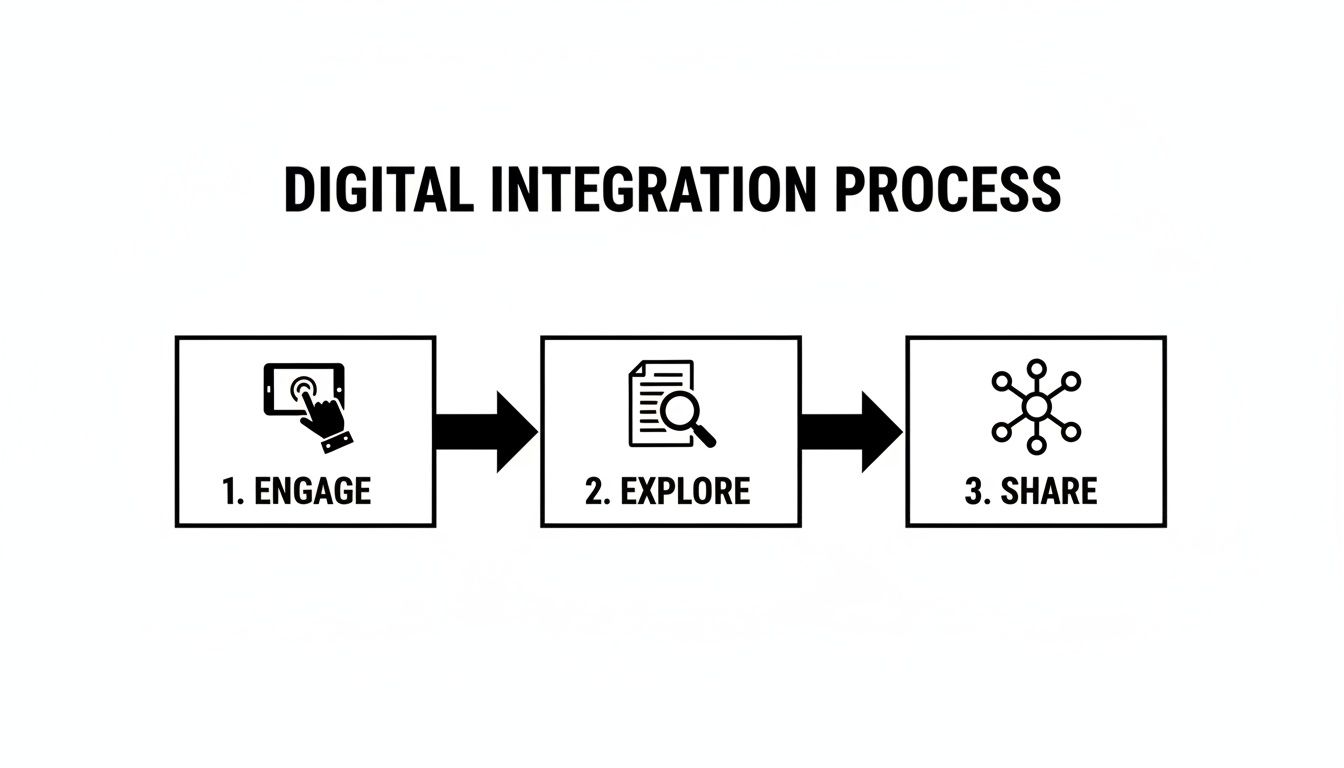
The process is designed to move a viewer from initial engagement to exploring donor stories and then sharing that impact, creating a powerful cycle of inspiration.
Creating a Realistic Project Timeline
A well-defined timeline is your project's roadmap. It keeps everyone aligned and on track. Rushing the process almost always leads to costly mistakes or a final product that falls short of expectations. A realistic schedule prevents stress and allows for the thoughtful collaboration that's essential for a truly exceptional result.
A typical project flows something like this:
Concept and Design (4-8 Weeks): This phase is all about collaboration. It involves initial consultations, site visits, developing design concepts, and refining the final vision based on your feedback.
Fabrication and Production (8-12 Weeks): Once the design gets the green light, your wall goes into production. This timeline can shift depending on material sourcing and the complexity of the build.
Installation (1-2 Weeks): The final step is bringing it all to life. The physical installation can range from a few days to a couple of weeks for more complex, multi-component displays.
Key Insight: Building a collaborative team from day one is the single most important factor for success. Your project team should include key players like development officers, facilities managers, and marketing staff. This ensures the final wall not only looks beautiful but also functions perfectly within your space and actively supports your fundraising goals.
For a deeper dive, you can learn more about how to plan and budget for your donor wall project in our comprehensive guide.
Keeping Your Donor Wall a Living Stewardship Tool
Here’s a secret many organizations miss: the day your donor wall is installed isn't the end of the project. It’s the beginning of its life as a powerful stewardship tool. A thoughtfully designed scalable donor wall is so much more than a static "thank you" for past gifts. It’s a living, breathing part of your fundraising strategy, creating constant opportunities to build and deepen relationships with your most important supporters.
When you treat the wall as an active asset, you shift recognition from a one-time transaction to an ongoing conversation. The trick is to weave the physical display into the very fabric of your organization’s communications and events. This keeps it fresh, celebrated, and a constant source of inspiration for future giving.
Activating Your Wall for Ongoing Engagement
Your scalable wall is the perfect backdrop for creating exclusive, memorable experiences that make donors feel truly seen and valued. The moment a new name goes up is a golden opportunity to show your gratitude in a personal, meaningful way. Don't just quietly add a plaque—make an event out of it.
Here are a few ideas I've seen work wonders:
Host Intimate Recognition Events: When adding a new major donor or a group from a successful campaign, host a small unveiling ceremony right at the wall. This could be a private breakfast or a champagne toast with your organization's leadership. It makes the moment special.
Celebrate Campaign Milestones: Use the wall as the centerpiece for celebrating fundraising milestones. Gathering in front of the display physically connects a campaign's success to the community of supporters who made it happen.
Integrate It into Tours: Make the donor wall a deliberate and important stop on any tour for prospective supporters, board members, or community partners. Use it as a visual aid to tell the story of your organization's growth and the very real impact of philanthropy.
The most effective donor stewardship is both personal and consistent. Using your scalable wall for small, exclusive events transforms a static display into a dynamic venue for celebrating generosity and building lasting loyalty.
Amplifying Recognition Beyond the Physical Space
The influence of your donor wall shouldn't be confined to the hallway it's in. By bringing it into your digital communications, you can amplify its message and reach a much broader audience—including donors who may not visit your facility regularly. This approach keeps the spirit of recognition alive and current.
For example, when a new set of names goes up, take a high-quality photo and feature it prominently in your next e-newsletter. You could pair this with a short story about the program their gifts supported. If your wall has digital components, share screenshots or short video clips of new donor profiles on your social media channels, tagging supporters where it's appropriate.
This simple act of sharing reinforces how much you value every contribution and shows your entire community that their support is seen and celebrated. It proves that designing scalable donor walls for growing organizations is ultimately about creating a sustainable culture of gratitude that fuels your mission for years to come.
Common Questions About Scalable Donor Walls
Even with the best strategy, a few key questions always come up when planning a scalable donor wall. Getting the answers right from the start is what ensures your investment looks great and functions perfectly for years to come. Let’s tackle some of the most common ones we hear from organizations just like yours.
One of the first is always about the budget: “Is a scalable wall more expensive upfront than a traditional one?”
The honest answer is that a modular or hybrid system might have a slightly higher initial design and infrastructure cost. But that initial investment is what prevents the massive expense of a complete tear-down and replacement later on.
Think about it over a ten-year period. A scalable wall is almost always the more cost-effective choice. It turns future additions into predictable, manageable expenses instead of a sudden capital crisis.
How Do We Handle Donor Name Corrections?
Another very real concern is what to do about the inevitable—a misspelled name or a requested update. With a static, engraved wall, a simple typo can be a nightmare, often forcing you to remake an entire panel. This is where modular systems are a true lifesaver.
Magnetic Plaques: A nameplate can be reprinted and replaced in seconds. Seriously, it's that easy.
Individual Plaques: A single incorrect plaque can be unscrewed and swapped out without disturbing the rest of the display. No drama, no massive expense.
Digital Displays: Updates are as simple as logging into the content management system (CMS) and making a quick edit from your desk.
This flexibility means you can always honor your donors with the accuracy and respect they deserve, which is a cornerstone of great stewardship.
A scalable system isn't just about adding new names; it's about the ability to easily manage and maintain the integrity of the names already there. This adaptability is a core part of its long-term value.
Finally, organizations often ask, "How do we start small if our budget is limited?"
The beauty of this approach is that you can begin with a strong, beautiful core that looks complete on day one. You plan the full, expanded vision from the get-go, but you only fabricate and install the first phase.
This lets you launch your recognition program with a professional, high-impact display while giving you a clear, pre-designed roadmap for future growth as more funds become available. It's the best of both worlds.
Ready to create a donor wall that grows with your mission? The team at Stobbe Design specializes in crafting beautiful, scalable recognition systems tailored to your organization. Let's start the conversation.


Comments