
Donor Walls: should the wall tell a story or strictly recognize donors?
So, should your donor wall tell a story or just recognize donors? The best modern installations actually do both. They've moved beyond static lists of names to become dynamic, narrative-driven displays that forge a much deeper connection.
Defining Your Donor Wall's Purpose
Before you even think about materials or design, you have to ask the most important question: what do we want this wall to do?
Is its main job to honor a long tradition of giving? Or is it a tool to bring in new support by showing off the impact of your mission? The answer—storytelling versus recognition—will guide every single decision you make from here on out.
This isn't just about looks; it's a strategic move that directly affects your donor relationships, fundraising success, and how you communicate what your organization is all about. A wall that simply lists names serves a crucial purpose by fulfilling the promise of public acknowledgment, which is a big motivator for many top-tier donors. But a wall that weaves in a narrative can turn a passive display into an active engagement tool, educating visitors and inspiring a real, human connection.
Core Philosophies at a Glance
Getting a handle on the fundamental differences between these two approaches will help clarify which path is right for your goals, both now and down the road. While a traditional recognition wall is all about celebrating the who, a storytelling wall shines a light on the why and how behind every gift.
Think of it this way: a university building a new law school might go for a classic, recognition-focused wall made of bronze and mahogany. That choice screams prestige and permanence, appealing directly to alumni who value tradition and legacy.
On the other hand, a children's hospital would probably get more mileage from a vibrant, interactive display that shares patient recovery stories. This connects donations directly to lives changed and pulls at the heartstrings of a broader community audience.
This table breaks down the two philosophies at a high level.
Quick Comparison of Donor Wall Philosophies
This table provides a high-level summary of the two primary approaches to donor wall design, highlighting their core focus, primary audience, and intended impact.
Attribute | Strict Recognition Wall | Storytelling Wall |
|---|---|---|
Primary Goal | To honor and thank donors publicly | To illustrate the impact of donations |
Core Message | "We are grateful for your support." | "Look what we accomplished together." |
Audience Focus | Current and major donors, legacy families | General public, potential new donors, staff |
Emotional Impact | Gratitude, pride, sense of belonging | Empathy, inspiration, emotional connection |
Design Focus | Hierarchy, elegance, permanence, clarity | Engagement, narrative, dynamism, accessibility |
Ultimately, the question of storytelling versus recognition is just the start of a much deeper conversation.
The most successful organizations have stopped seeing their donor walls as just a list of supporters. They see them for what they truly are: a powerful communication asset that reinforces their mission and builds a community around a shared purpose.
Comparing Storytelling and Recognition Donor Walls
Deciding whether your donor wall should tell a story or strictly recognize donors is one of the most fundamental choices you'll make. This isn't just about aesthetics; it’s a strategic decision that will define how your audience connects with your mission for years to come. The two approaches serve different, though sometimes overlapping, purposes.
A recognition-focused wall is a formal record of gratitude, an elegant ledger of support. On the other hand, a storytelling wall acts as a mission-driven exhibit, aiming to educate, inspire, and forge a deep emotional connection with everyone who sees it.
Let's break down how these two philosophies really stack up.
Donor Engagement: Passive Acknowledgment vs. Active Inspiration
The biggest difference comes down to how each wall type engages its audience. A traditional recognition wall is often a passive experience. Donors and their families find their names, feel a sense of pride and belonging, and see the organization's gratitude made tangible.
This kind of engagement is valid and powerful, especially for major benefactors who expect prominent acknowledgment. It fulfills a key promise and cements their place in your organization's history. But for a visitor with no personal connection to the names listed, the experience often ends right there.
In contrast, a storytelling wall is designed for active engagement. It invites viewers to pause, read, and connect with the human impact of philanthropy.
By featuring patient recovery stories, student testimonials, or images of a thriving ecosystem, the wall transforms from a static list into a dynamic narrative. It doesn't just thank donors; it demonstrates why their support matters, inspiring new and existing supporters in a completely different way.
A recognition wall makes a donor feel seen; a storytelling wall makes a visitor feel moved. The first secures a legacy, while the second builds a broader community of advocates.
Emotional Connection: Gratitude vs. Empathy
Both approaches aim to stir emotion, but they target very different feelings. A wall that strictly recognizes donors is all about fostering gratitude and pride. The message is crystal clear: "We are grateful for these individuals and their contributions." For the donors themselves, this public validation can be deeply satisfying.
A storytelling wall, however, works to cultivate empathy. When a hospital visitor reads about a child who received life-saving care funded by donations, they connect not just with the institution, but with the people it serves. This empathetic link is an incredibly powerful motivator for future giving.
This infographic really gets to the heart of the core purpose behind each approach, from listing names to showing true impact.
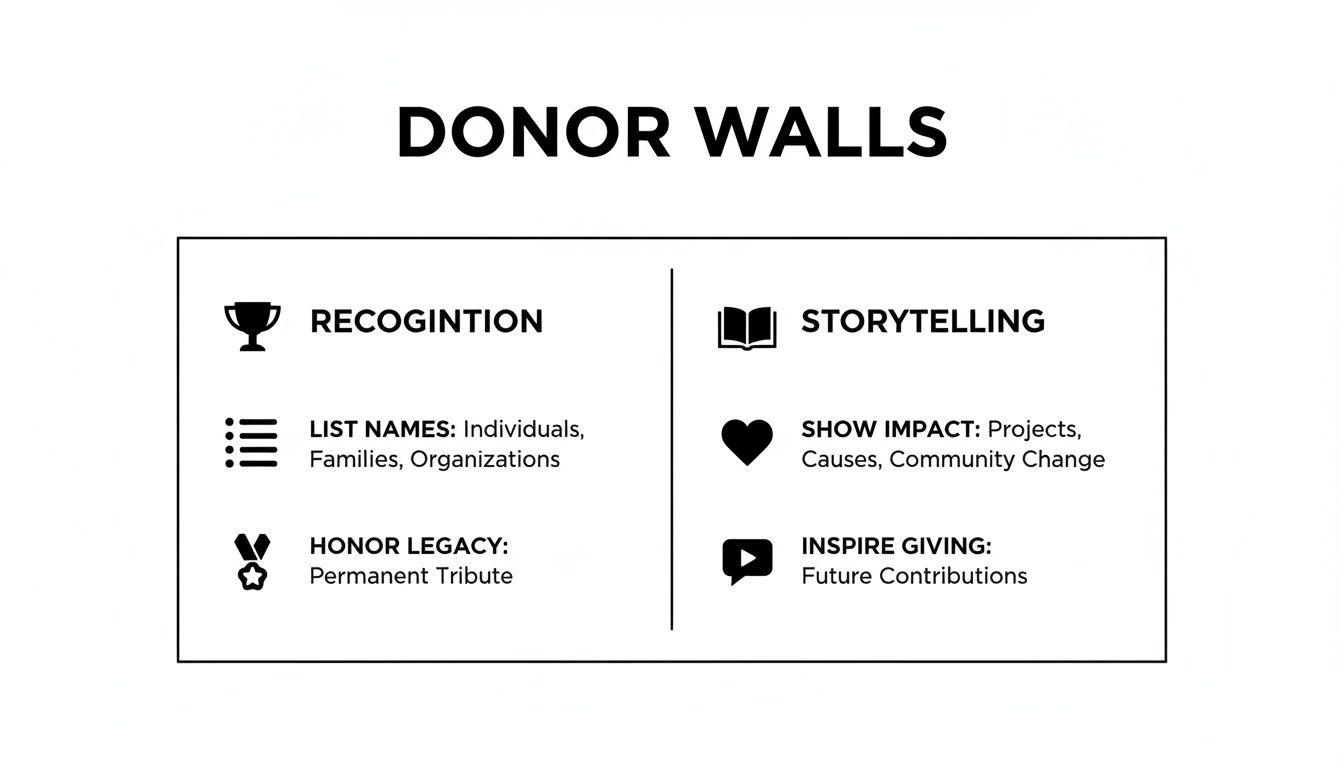
This visual highlights a fundamental choice: Recognition focuses on celebrating the "who," while storytelling emphasizes the "why."
Mission Reinforcement: Listing Supporters vs. Illustrating Impact
Every donor wall should reinforce your mission, but each type goes about it differently.
A recognition wall reinforces the mission by showcasing the community of supporters who believe in it. It sends a strong signal that your organization is a worthy and stable recipient of major philanthropic investment. The sheer volume and prominence of names can communicate credibility and success all on its own.
A storytelling wall reinforces the mission by making it tangible. Instead of just implying impact through a list of names, it explicitly shows it. For an environmental nonprofit, this could be a display showing acres of land preserved; for a university, it might be an interactive feature on scholarship recipients who became leaders in their fields.
Think about these two different paths:
Recognition Wall: A university's law school features an oak-paneled wall with brass plates listing donors to its endowment. The message is one of tradition, prestige, and enduring legacy.
Storytelling Wall: A community food bank uses a digital display to show real-time statistics on meals served, accompanied by short video interviews with volunteers and clients. The message is one of immediate, tangible impact.
Influence on Future Giving: Competitive Giving vs. Inspired Giving
Finally, how does each approach influence your fundraising down the road? Your choice here can attract entirely different kinds of future support.
Recognition walls, with their clearly defined giving levels, can foster a sense of competitive giving. Prospective donors might see the names of their peers and feel motivated to give at a similar or higher level to earn the same public acknowledgment. This can be highly effective for capital campaigns or within tight-knit communities.
Storytelling walls, on the other hand, tend to spark mission-aligned giving. A visitor moved by a powerful story may feel compelled to contribute—even at a modest level—because they now understand the direct impact their gift can have. This approach broadens your potential donor base far beyond those seeking public recognition, appealing to anyone who connects emotionally with your cause.
The good news is that the choice isn't always one or the other. Many of the most successful organizations use hybrid models that blend elegant recognition with compelling narratives. But understanding these core distinctions is the first step toward creating a donor wall that not only expresses gratitude but also powerfully advances your mission.
Choosing Your Approach Based on Your Strategic Goals
Deciding between a storytelling wall and a classic recognition wall isn't just a design choice. It's a strategic one. The right path depends entirely on what you need the wall to do for your organization in the long run. Are you trying to honor a legacy, or are you building a tool for future growth?
For many, the main goal is simply to honor tradition and meet donor expectations. A strict recognition wall does this masterfully. It's a clear, powerful statement of gratitude, it establishes a visible hierarchy of giving, and it stands as a testament to the community that built and sustains your work.
When to Prioritize Strict Recognition
A recognition-first wall is often the smartest choice when your objectives are rooted in tradition and honoring your most significant benefactors. This approach sends a clear message of prestige, stability, and deep appreciation—a vital signal for certain institutional cultures.
Think about these scenarios where a recognition-first approach really shines:
Honoring Founding Families and Legacy Donors: A historical society or a century-old university often needs to prominently feature the names of families who provided foundational support for generations. In this case, the wall is both a historical record and the fulfillment of a long-held promise.
Fulfilling Major Donor Expectations: During a major capital campaign, top-tier donors often give with the expectation of prominent, permanent recognition. A classic wall with names etched in bronze or glass meets that expectation head-on. You can learn more about how a donor wall is tied to a specific campaign in our detailed guide.
Reinforcing a Culture of Philanthropy: For an established medical center or law school, a wall filled with the names of respected community leaders acts as powerful social proof. It encourages peers to give at similar levels to join that distinguished group.
When to Lead with Storytelling
On the flip side, a storytelling wall becomes your greatest asset when your goals are centered on education, forging an emotional connection, and expanding your base of support. This approach moves beyond just thanking the "who" to powerfully demonstrating the "why" and "how" behind your mission.
A narrative-driven wall is the perfect fit in these situations:
Demonstrating Tangible Impact: A children's hospital can use its wall to share patient recovery stories, complete with photos and heartfelt testimonials. This makes the impact of a gift immediate and deeply personal, connecting with every visitor who walks by.
Educating the Public and Inspiring New Donors: Imagine an environmental nonprofit using an interactive display to show the acres of land preserved or highlight the return of a native species—all directly linked to donor support. This educational angle can inspire first-time gifts from a much wider audience.
Cultivating a Broader Community Connection: For a community arts center, a wall featuring videos of student performances or quotes from local artists makes the space feel more inclusive and alive. It showcases the organization as a vital community hub, not just a place that needs funding.
A recognition wall solidifies relationships with your existing core supporters. A storytelling wall opens the door to your next generation of donors by making your mission irresistible.
The data is increasingly clear: dynamic storytelling can seriously boost engagement. Take the compelling case from Midwest University Foundation. They replaced a static list of names with an interactive digital display, and the effect was remarkable. Donor engagement soared by 73%, and attendance at stewardship events jumped 42% when the new story-focused wall was featured.
Ultimately, the question isn't just "storytelling or recognition?" It's "what is our primary objective?" If your goal is to honor a legacy and acknowledge major contributors in a traditional, dignified way, a recognition wall is a timeless and effective choice. But if you're aiming to inspire new audiences, demonstrate your impact, and build a broader community, a storytelling approach will deliver far greater returns.
The Rise of Dynamic and Mixed Media
Storytelling walls often push beyond static displays, embracing dynamic and mixed-media installations. This is where technology and creativity combine to build truly immersive experiences. Digital screens can cycle through donor lists, share impact videos, and show live campaign updates, keeping the narrative fresh and current. You can find some inspiring feature wall ideas to see how different materials and approaches can create an incredible focal point.
Interactive touchscreens transform passive viewing into active engagement, inviting visitors to explore stories at their own pace. We’re also seeing more organizations find success by blending the old with the new, creating hybrid solutions that offer the best of both worlds. To dig deeper into this, you can explore the pros and cons of digital vs traditional donor walls and figure out the right fit for your space.
Ultimately, your design and materials have to work together, aligning with your brand and the architecture of the space itself. Whether you choose the quiet dignity of etched glass or the vibrant energy of a digital display, the final piece should feel like a natural extension of your mission—powerfully communicating your message of gratitude and impact.
Before you make a final call, it’s always a good idea to consult with key stakeholders and major donors. Their perspective is invaluable. Understanding what they expect is crucial to creating a wall that celebrates giving in a way that feels respectful and right for your entire community.
At Stobbe Design, we specialize in crafting custom donor recognition walls that perfectly balance storytelling and gratitude. From initial concept to final installation, we create displays that honor your supporters and powerfully communicate your mission. Explore our portfolio and start your project with us today.


Comments