
How to intergrate planned giving into the donor recognition wall: Quick guide
Integrating a planned gift into a donor recognition wall isn't just a simple update. It’s a strategic decision that turns a future promise into a tangible, celebrated reality today.
Think of it this way: you’re validating your most committed supporters, educating the entire community about powerful giving options, and shoring up your organization's financial future—all at once. This simple, visible act of honor is a game-changer for your long-term fundraising culture.
Why Recognizing Planned Gifts Is a Game Changer
Planned gifts—bequests, trusts, annuities, you name it—often represent the single largest contributions an organization will ever receive. Fundraising experts have seen time and again how these commitments can make up a huge piece of a nonprofit’s long-term revenue. Highlighting these donors isn't just a nice gesture; it’s a strategic imperative for financial stability.
Plus, visible recognition demystifies the whole concept of legacy giving. When visitors see a "Legacy Society" or "Heritage Circle" section on your wall, it sparks curiosity. It normalizes this profound form of philanthropy, making it feel accessible and real.
Shifting from Transaction to Legacy
A donor wall that includes planned givers tells a much more complete story. It moves beyond just acknowledging immediate cash donations to celebrating a deeper, lifelong commitment to your mission. I've seen this shift have some incredibly powerful effects:
It Inspires Others: Seeing peers honored for their future gifts gets current donors thinking about their own legacy. It's a quiet but persuasive nudge.
It Validates Donors: Public acknowledgment makes a planned giver feel like a cherished part of your organization's history, right now. It affirms their decision and deepens their connection.
It Educates the Community: Every visitor learns about different ways to support your cause. You're planting seeds for conversations they'll have down the road.
This public display of gratitude is just good stewardship. It shows you value the intention and trust behind the promise, not just the eventual transaction.
By honoring tomorrow's gifts today, you are not just thanking a few; you are inviting everyone to imagine the lasting impact they can create. It's a powerful signal that your organization is built for the future.
Recognizing these gifts sends a clear message about your organization's stability and foresight. Take a look at the key benefits this simple addition can bring.
Key Benefits of Integrating Planned Giving Recognition
Benefit | Impact on Organization |
|---|---|
Increased Visibility | Normalizes legacy giving and keeps it top-of-mind for all visitors. |
Donor Validation | Makes legacy donors feel appreciated and connected today, not just in the future. |
Peer Motivation | Encourages other major donors to consider their own planned gifts. |
Educational Tool | Subtly teaches the community about diverse ways to support your mission. |
Enhanced Credibility | Signals long-term financial planning and sustainability, boosting confidence. |
As you can see, the ripple effects are significant, touching everything from donor relations to your public image.
Building a Lasting Culture of Philanthropy
Adding these names to your wall is a clear signal that your organization is thinking about its long-term health. It shows you have a plan that extends far beyond the current fiscal year, which builds confidence among all your supporters.
As donors increasingly explore modern estate planning, they're becoming more familiar with their options. Having resources that explain the benefits and drawbacks of creating an online will and trust can be a helpful touchpoint in their journey.
Ultimately, a thoughtfully designed recognition space that includes planned givers does more than just list names. It actively works to https://www.stobbedesign.com/post/how-donor-walls-boost-fundraising-and-inspire-generosity across your entire donor base.
Building a Rock-Solid Recognition Policy
Before you even think about engraving a name or programming a digital display, you need to lay the groundwork. The single most important first step is creating a thoughtful, comprehensive policy for recognizing planned gifts. This document is the bedrock of your entire strategy. It ensures fairness, prevents awkward misunderstandings, and gives your team a clear roadmap for every decision—both now and for years to come.
Without a formal policy, you’re basically inviting inconsistency and setting yourself up for difficult conversations. Just imagine a well-meaning board member promising prominent recognition for a verbal pledge that doesn't quite meet your standards. A solid policy protects you from these one-off decisions and keeps your program professional and sustainable.
Defining What Qualifies for Recognition
First things first, your policy needs to tackle the big question: what exactly is a “recognized” planned gift? There’s no single right answer here, but you absolutely have to choose a path and get it down in writing. The two main schools of thought are recognizing intent versus recognizing irrevocable commitments.
Recognizing Intent: This approach is all about honoring donors as soon as they provide documentation of their intentions. This could be a signed pledge form or a copy of the relevant part of their will or trust. It's a fantastic stewardship tool that lets you celebrate and engage with donors during their lifetime.
Recognizing Irrevocable Gifts: This is a more conservative route. With this policy, you reserve public recognition for legally binding commitments that can’t be changed, like a charitable gift annuity or a charitable remainder trust.
Many nonprofits land on a hybrid model. For instance, you might include anyone with a documented intention in a general "Legacy Society" listing, but reserve more prominent, individual recognition for those irrevocable gifts.
Establishing Clear Recognition Tiers
Just like in your annual or capital campaigns, creating tiers is crucial for managing your donor wall space and honoring gifts in a way that feels appropriate. Your policy needs to define these levels explicitly. Using vague terms like "major gifts" just won't cut it.
You need to establish clear, unambiguous thresholds. For example:
Collective Recognition: All documented planned gift intentions are included in a collective listing for your "Legacy Society."
Tier 1 Individual Recognition: Pledges valued at $50,000 to $99,999 receive a nameplate on a specific section of the wall.
Tier 2 Individual Recognition: Pledges valued at $100,000 or more receive a larger nameplate or placement in a more prominent location.
Having these tiers defined in black and white removes all the guesswork. When a donor asks how they can be recognized, you have a clear, equitable answer ready. It transforms a potentially awkward conversation into a transparent and inspiring one.
This whole process is a core part of your organization's governance. To build a truly robust framework, understanding the difference between policy and procedures is essential. Your policy sets the "what" and "why," while your internal procedures will later spell out the "how."
Handling Sensitive and Practical Details
A great policy anticipates the nuanced, real-world situations that will inevitably pop up. Your document should give your team clear guidance on several key issues, ensuring every donor interaction is handled with grace and consistency. Think of this policy as a strong foundation that complements your organization's other governance documents. For a deeper dive, our guide on gift acceptance policies for nonprofits explained offers some great context.
Here are a few key questions your policy must answer:
Anonymity: What’s the protocol if a donor wants to remain anonymous? A common practice is to include a simple line like, "With gratitude to our donors who wish to remain anonymous."
Wording and Naming Conventions: How will names actually be listed? Will it be "Mr. & Mrs. John Smith" or "Jane and John Smith"? What about posthumous gifts—"The Estate of Jane Doe" or "A Legacy Gift from Jane Doe"? Decide on a standard and stick to it for consistency.
The Update Process: How and when will the wall be updated? For physical walls, a modular design is often your best friend. Your policy should nail down a timeline (annually, for example) and a budget for updates to ensure the wall stays current and accurate.
By thinking through these details upfront, you create a policy that doesn't just guide your team—it honors the profound generosity of your planned giving donors with the deep respect they truly deserve.
Designing a Wall That Tells a Legacy Story
Once your policy is locked in, the real fun begins. It's time to move from governance to the exciting part—visualizing a space that truly honors your legacy donors. This is where your vision meets reality.
The goal here is to get away from a static, forgettable list of names. We want to create an installation that tells a compelling story of enduring commitment. A powerful donor wall does more than just say "thank you"; it educates, inspires, and becomes a destination within your facility. It's a chance to visually represent the deep trust your planned giving donors have placed in your organization's future.
Establishing a Dedicated Legacy Space
I’ve found that one of the most effective strategies is to create a distinct, dedicated section just for your planned givers. This visually separates their unique commitment from annual or capital campaign gifts, giving it the special status it absolutely deserves. Think of it as creating a "Heritage Circle" or a "Legacy Wall."
This approach elevates the very act of planned giving. It signals its importance to every single person who walks by. To make this space feel even more significant, think about using different materials. While your main wall might use acrylic or glass, the legacy section could feature timeless materials that evoke a sense of permanence and history.
Aged Wood: Conveys warmth, history, and a connection to your foundational roots.
Brushed Bronze or Brass: Offers a feeling of prestige, permanence, and classic elegance.
Etched Glass: Creates a sophisticated, modern aesthetic that feels both light and substantial.
By simply changing the material palette, you create an immediate visual cue that this group of supporters is being honored for a particularly profound and forward-thinking commitment.
Embracing Digital and Hybrid Solutions
While traditional walls are beautiful, modern tech offers incredible flexibility, especially when you need to integrate planned giving into the donor recognition wall. Digital and hybrid solutions aren't just about looking futuristic; they solve very real, practical challenges and deepen your storytelling potential.
A digital wall is infinitely scalable. You can add new members to your Legacy Society with a few keystrokes, avoiding the cost and logistical headache of ordering and installing new physical plaques. For a growing program, this is a huge advantage.
Digital displays transform recognition from a static list into a dynamic story. Imagine a visitor touching a donor's name on a screen and seeing a short video where that person shares why they chose to leave a legacy, or a photo gallery showing the impact of a past realized gift.
This kind of interactive element makes the act of giving deeply personal and relatable. It inspires others in a way a simple name on a wall never could.
Weaving a Unified Pathway of Philanthropy
Sometimes, creating a completely separate wall just isn't feasible because of space or design constraints. In those cases, the goal is to visually integrate planned gifts into your existing recognition structure, creating what you might call a "Pathway of Philanthropy."
This approach showcases the full spectrum of support your organization receives, from first-time gifts all the way to ultimate legacy commitments. It’s a beautiful way to tell a holistic story.
You can achieve this integration in several creative ways:
Distinct Symbols: Add a small, elegant symbol (like an infinity loop or a small leaf icon) next to the names of donors who have also made a planned gift commitment.
Color Coding: Use a different color for the text or the nameplate itself to distinguish legacy society members within your main giving tiers.
Material Accents: Inlay a small bronze medallion or a different type of wood into the nameplates of your planned givers.
These subtle design choices create a cohesive look while still providing that special acknowledgment. They elegantly show how donors can support your mission in multiple ways throughout their lives. The entire installation becomes a more complete narrative. To see this concept in action, you can learn more about how to build a donor wall that tells a story. This approach can be a powerful way to guide supporters on their philanthropic journey with your organization.
Getting the Words Just Right
The language you use to honor a legacy gift is incredibly important. This is your chance to move beyond a simple name on a wall and tell a story of commitment, vision, and trust. The right words don't just say "thank you"—they convey the depth of your gratitude and inspire others to think about their own impact.
Authenticity is everything here. Your message should feel warm, genuine, and heartfelt, not like it was pulled from a generic template. You're acknowledging the profound faith a donor has placed in your organization's future, and your words need to reflect that with grace and respect.
Language for Individuals, Couples, and Families
Getting the recognition right starts with attention to detail. Your policy should provide a consistent framework, but every donor's situation is unique, and your wording should honor that.
For Individuals: Simple and elegant is often the best approach. Think "A Legacy Gift from Jane M. Smith" or "Honoring the Enduring Vision of John D. Miller." Both are classic, clear, and respectful.
For Couples: Always acknowledge both partners. Wording like "With Gratitude for the Legacy of Jane and John Smith" is a great option. If they have a family name they prefer, "Celebrating the Generosity of the Smith Family" works beautifully.
For Families: When a gift comes from a deep, multi-generational commitment, you’ll want to broaden the acknowledgment. "A Legacy of Philanthropy from the Miller Family" or "The Miller Family Heritage Fund" are two excellent ways to do this.
These aren't just points of etiquette. They are a fundamental part of making your donors feel truly seen and valued for who they are.
Handling Posthumous Acknowledgments with Grace
When a planned gift comes to fruition after a donor has passed away, the language requires the utmost sensitivity. This is a moment to honor a memory and celebrate a final, beautiful act of generosity. Your team needs to be ready to work with the donor's family or estate with compassion and care.
The wording here is critical. A few common, respectful phrases include:
"In Loving Memory of Jane M. Smith"
"From the Estate of John D. Miller"
"A Bequest from the Jane M. Smith Charitable Trust"
The right choice often comes down to the specifics of the gift and, most importantly, the family's wishes. Always, always confirm the preferred language with the estate's executor. This ensures your public acknowledgment perfectly aligns with how the family wants their loved one to be remembered.
Sample Wording for Different Formats
Your message needs to fit the medium. What works on a grand, permanent plaque might feel stiff or out of place in a digital story or a speech. You'll need to tailor your language accordingly.
Format | Sample Wording Example | Key Consideration |
|---|---|---|
Physical Plaque | "Honoring the Visionary Members of Our Legacy Society" (for a collective list) | Focus on language that is timeless, concise, and elegant. |
Digital Story | "Jane Smith believed in a future where every child could read. Her legacy gift ensures our library will serve generations to come." | Use storytelling and emotion to directly connect the gift to your mission's impact. |
Event Speech | "Tonight, we celebrate John Miller, whose future gift will build the foundation for our next 50 years of service." | Be warm, personal, and forward-looking to connect with and inspire the audience. |
The most powerful recognition language bridges the gap between the donor's personal values and your organization's mission. It answers the question, "Why did this person entrust us with their legacy?" and inspires others by showing the profound impact of their foresight.
Ethical and Legal Guardrails
This is the most important part: all recognition language must strictly follow the donor's documented wishes. The Gift Agreement is your single source of truth.
If a donor specified the exact wording they wanted, requested to remain anonymous, or provided any other instructions, you are bound to follow them. No exceptions.
This isn't just an ethical responsibility—it's a legal one. Straying from a signed agreement can seriously damage your organization's reputation and lead to legal headaches you don't need. A smart safeguard is to have a clear process where both your development and legal teams review any high-level recognition language before it goes public. This ensures every message is not only inspiring but also perfectly compliant.
Bringing Your Vision from Workshop to Hallway
You've done the hard work. The policy is thoughtful, the design is compelling, and now it's time for the most exciting part: bringing your vision off the page and into your hallway. This is where abstract plans become a tangible, inspiring reality.
Getting this final phase right hinges on meticulous coordination between your team, your chosen fabricator, and your facilities staff. It's a true partnership, and clear communication is everything.
From Fabrication to Installation
Choosing the right materials is about so much more than just looks—it’s a statement about permanence and value. When we talk about physical installations, the environment is key. A high-traffic lobby demands durable materials like brushed metal, stone, or thick acrylic that can stand up to daily life.
Always ask your fabricator about longevity and maintenance. How will these materials look in five, ten, or even twenty years?
Digital displays, on the other hand, bring a whole different set of conversations to the table. This is where your facilities team needs to be looped in from the very beginning. Nothing stalls a project faster than discovering you don't have the right infrastructure.
Here’s a practical checklist for that conversation:
Power Supply: Where will the display get its electricity? Does it need its own dedicated circuit to avoid issues?
Data Connectivity: Will a hardwired internet connection be needed for updates, or is the Wi-Fi in that area strong and reliable enough?
Ventilation: High-definition screens generate heat. They need proper airflow to function reliably over the long haul.
Structural Support: This is a big one. Is the wall itself capable of safely holding the weight of the display and all its mounting hardware?
Sorting these details out well in advance prevents those costly and frustrating last-minute scrambles. When you plan ahead, your facilities team becomes a crucial partner, not a hurdle.
Planning a Meaningful Unveiling
The launch of your new or updated donor wall is a golden stewardship opportunity. Don't just flip a switch or pull a velvet curtain—make it a moment. This is your chance to celebrate the culture of philanthropy you're building. Think of the unveiling as a strategic event, not just an afterthought.
Consider hosting an exclusive reception just for your Legacy Society members. This gives you the perfect occasion to honor them in an intimate setting before revealing the wall to your wider community. It puts them at the center of the story and shows just how much you value their incredible foresight and commitment.
An unveiling event transforms the recognition wall from a simple installation into a celebrated milestone. It’s a chance to personally thank your legacy donors and publicly affirm the vital role they play in securing your organization's future.
After the event, your launch strategy should continue to ripple outward. This new installation is a powerful visual asset. The infographic below shows how donor messaging shifts depending on the recognition scenario.
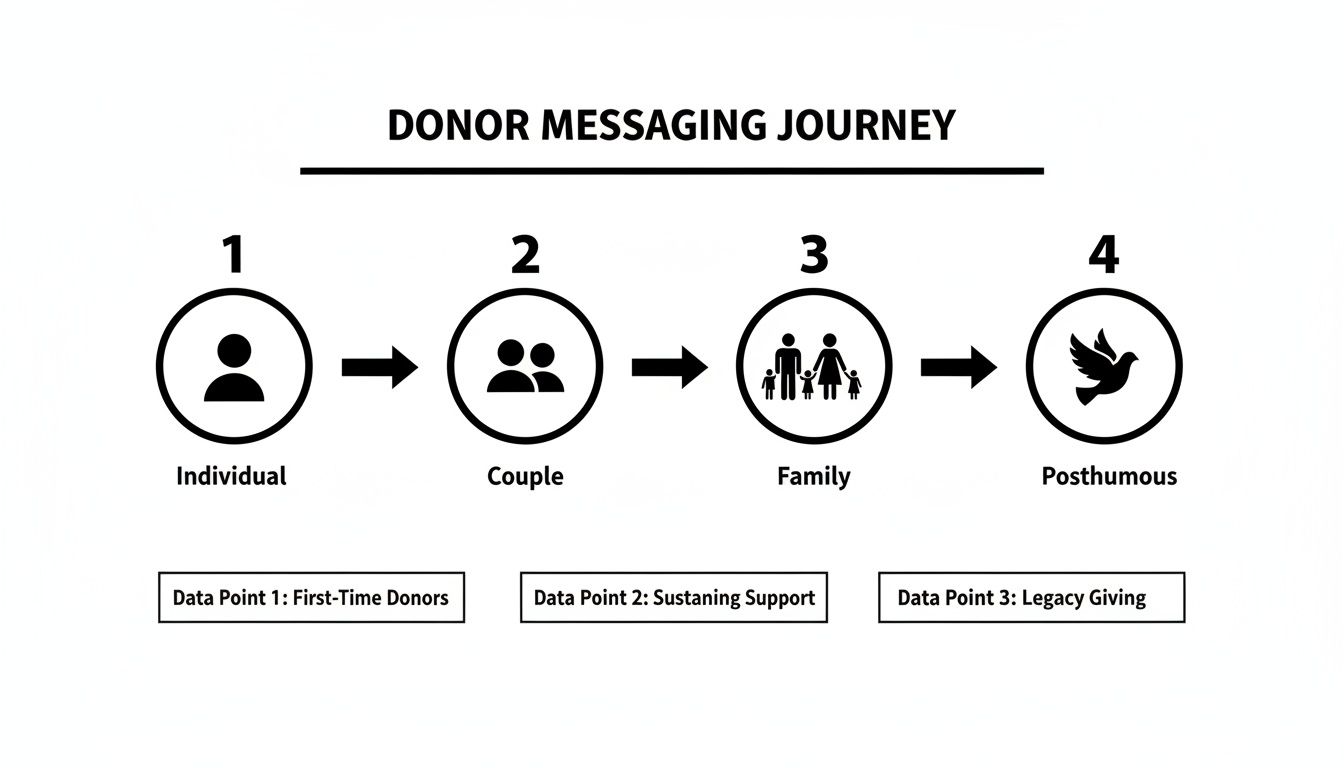
This flow highlights just how important it is to adapt your language, whether you're celebrating an individual's vision, honoring a family's collective generosity, or handling a posthumous gift with grace and care.
Maximizing the Inspirational Impact
Your new wall isn't just a static display; it should be a living, breathing part of your fundraising ecosystem. To really maximize its impact, you have to actively integrate it into your communications. Don't just install it and hope people notice. Make it a focal point.
Here are a few practical ways to put your new installation to work:
Annual Report: Feature a beautiful, high-quality photograph of the wall in your next annual report. Better yet, place it alongside a story about one of your Legacy Society members.
Marketing Materials: Use images of the wall in your brochures, on your website's giving pages, and in social media posts. It's a powerful visual that communicates stability and gratitude.
Future Appeals: In upcoming fundraising letters, you can reference the wall as a symbol of lasting support, inviting others to add their names to this esteemed group.
Tours and Meetings: Make the wall a deliberate stop on any tour with prospective major donors. It's the perfect backdrop for discussing the future of your organization and the profound impact of legacy giving.
By strategically weaving your donor wall into these different channels, you ensure it does more than just recognize past generosity. You turn it into an active, persuasive tool that continually inspires future support and helps you successfully integrate planned giving into the donor recognition wall for years to come.
Common Questions on Planned Giving Recognition
Working through the details of planned giving recognition can feel tricky, but getting clear on a few common questions will give your team the confidence to handle any situation with consistency and grace. Honestly, most organizations are wrestling with the same sensitive issues, from donor privacy to the logistics of updating a display over time.
Having thoughtful, pre-planned answers ready isn't just an administrative task; it’s a cornerstone of great stewardship. These aren't just names on a wall—they represent the trust your most forward-thinking supporters have placed in you. Getting it right reinforces the integrity of your entire legacy program.
What if a Donor Wants to Remain Anonymous?
Respecting a donor's wish for anonymity is non-negotiable. Their privacy comes first, period. But that doesn't mean their generosity can't be acknowledged in a way that inspires others. The trick is to shift the focus from the individual to the collective spirit of giving.
A simple yet powerful way to do this is to add a collective message to a prominent part of your wall. Think of elegant, unifying phrases like:
"With deep gratitude to the visionary members of our Legacy Society who have chosen to give anonymously."
"Honoring the quiet generosity that secures our future."
This approach acknowledges their incredible commitment without revealing their identity. If you're using a digital display, you have even more freedom. You can spotlight the impact of their gift without a name attached, telling a story like, "A generous legacy gift has endowed our scholarship fund for future generations."
How Do We Handle Updates When a Gift Is Realized?
A planned giving wall should be a living document, not a static monument. It's crucial that your recognition policy outlines a clear, practical process for updates, especially for that sensitive moment when a planned gift is realized after a donor passes away. Thinking this through ahead of time prevents awkward delays and ensures the wall remains a current and respectful tribute.
For a physical wall, a modular design is your best friend. Systems with magnetic or rail-mounted nameplates make updates simple and keep costs down. Your policy might specify moving a donor's name from a "Legacy Society" list to a "Realized Gifts" section, or maybe adding a distinct, elegant symbol next to their name.
A documented procedure and a dedicated annual budget for updates aren't just nice to have—they're essential. This operational commitment ensures your wall accurately reflects your donors' journeys and honors their ultimate gift with the dignity it deserves.
Digital walls, of course, make this process a breeze, allowing you to make changes instantly with just a few clicks.
Should We Display Specific Gift Amounts on the Wall?
This one comes up a lot, and the answer is pretty straightforward: we strongly recommend avoiding specific dollar amounts for any donor, especially for planned gifts. Publicly displaying financial details can create a strange sense of comparison, cheapen the spirit of philanthropy, and make some of your donors deeply uncomfortable.
Instead, create recognition tiers or named societies that correspond to gift ranges defined privately in your policy.
Heritage Society
Founder's Circle
Visionary Partners
This lets you honor generosity appropriately without disclosing private financial information. It keeps the focus where it belongs—on the donor's visionary commitment to your organization's future, not on a number.
How Can We Ensure Smaller Gifts Are Included?
Every single planned gift, no matter the size, represents a profound commitment to your mission. Your recognition strategy has to be inclusive if you want to foster a broad and healthy culture of legacy giving. While a major gift might warrant an individual plaque, every commitment deserves to be celebrated.
Digital walls are fantastic for this because they can display a limitless number of names in a beautifully designed scrolling list. For physical installations, a handsome collective plaque honoring all members of your "Legacy Society" is a wonderful and unifying option.
Another powerful idea is to create a "Book of Legacy." This could be a beautifully bound physical book or a digital kiosk placed near your wall. It gives you a space to list every planned giver and, with their permission, share their personal stories. This creates a rich, detailed tapestry of support that makes every single donor a visible part of your history and is a perfect way to integrate planned giving into the donor recognition wall in a deeply meaningful and scalable way.
At Stobbe Design, we specialize in creating donor recognition walls that do more than just list names—they tell a story of commitment and inspire a future of giving. Our team works with you to design, fabricate, and install a beautiful, lasting tribute that honors every donor with grace. See how we can bring your vision to life at https://www.stobbedesign.com.

Comments