
Discover how to choose the right donor wall design for my organization?
Choosing the right donor wall design is about so much more than picking pretty materials. It's a strategic decision that needs to align your goals, audience, and mission into a single, cohesive storytelling tool.
It all starts by defining the wall's core purpose. Is this to celebrate a massive, one-time campaign, or is it meant to honor ongoing, year-over-year support? From there, every single element can be tailored to resonate with the specific donors you want to recognize and inspire.

Matching Your Donor Wall to Your Mission
Before you even think about fonts or finishes, the real work begins. You need to anchor your donor wall's purpose squarely within your organization's mission. This isn't just a list of names; it’s a powerful statement about your values and the community that makes your work possible.
Nailing this initial strategy is critical. It ensures the final design is both meaningful and effective, preventing a costly and frustrating misstep down the road.
Start with a fundamental question: Is this wall a static monument to a completed capital campaign, or is it a living, breathing tribute to ongoing annual support? A wall celebrating the founders of a new hospital wing will look and feel completely different from one that needs to gracefully accommodate hundreds of new community donors each year.
Define Your Primary Audience and Goals
You have to know who you're talking to. Is your primary audience made up of major philanthropists, grassroots community donors, or corporate partners? Each group has entirely different motivations and expectations when it comes to recognition.
A corporate sponsor, for instance, might really appreciate seeing their logo prominently displayed. A family foundation, on the other hand, may prefer a much more subtle and elegant acknowledgment.
Clearly defining your goals will guide every decision that follows. Think about what's most important for this specific project:
Celebrating a specific achievement, like funding a new building or a landmark endowment.
Inspiring future giving by showcasing the real-world impact of philanthropy.
Expressing sincere gratitude and making donors feel truly valued and seen.
Telling your organization's story through the lens of its dedicated community support.
A donor wall should be a true extension of your mission, not just a box to check. When its design tells a story that reflects your organization's heart, it transforms from a simple display into a source of inspiration and pride for your entire community.
Clarifying Your Message
Once you know your "why" and your "who," you can hone in on your message. This decision-making flowchart is a great way to visualize how your initial goals directly shape the design direction for your wall.
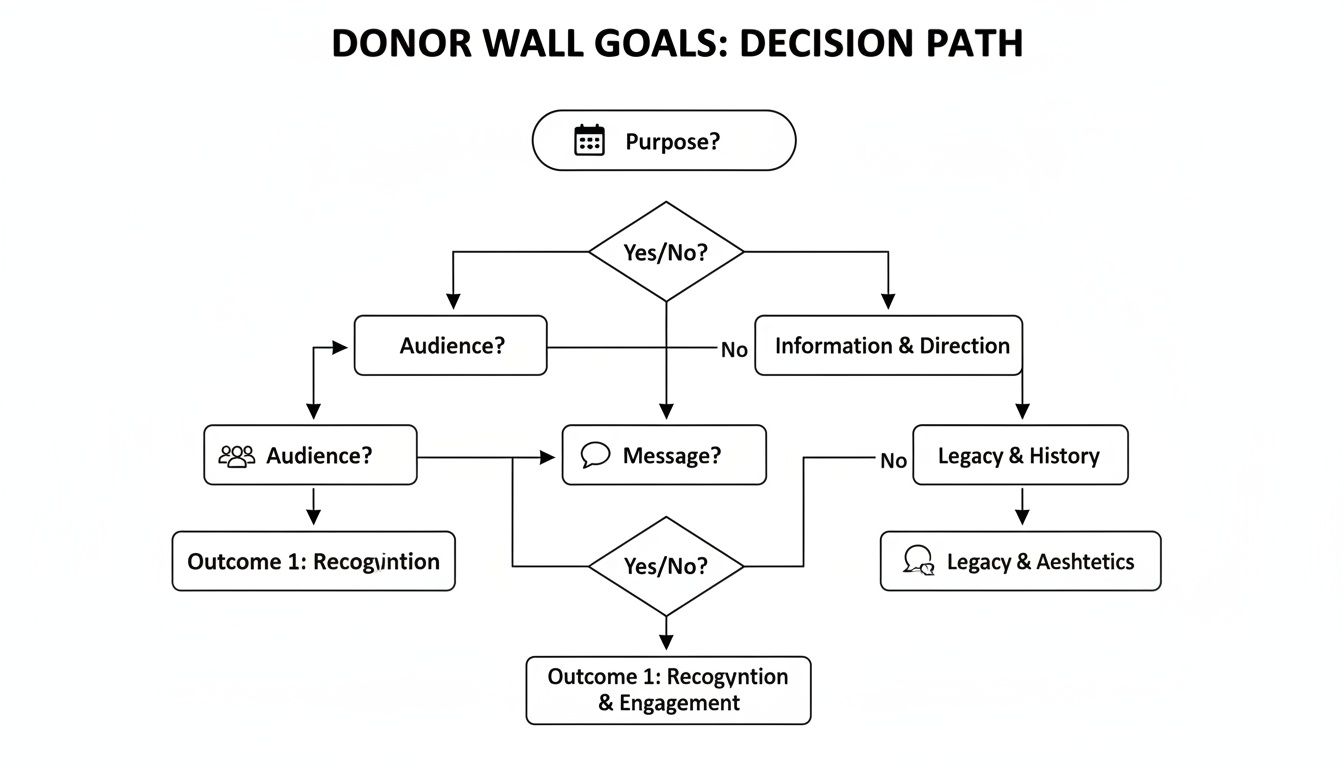
This visual guide shows how a clear purpose naturally leads to the right message, which in turn makes the design choices much simpler. The key takeaway is that getting your strategy aligned at the very beginning makes the entire process smoother and far more impactful.
If you want to dive deeper into this topic, you can explore whether donor walls should tell a story or strictly recognize donors in our detailed article. Getting this foundational work right gives you a solid base for a design that truly connects.
Finding the Perfect Location for Maximum Impact
A brilliant donor wall hidden in a forgotten corner is a monumental missed opportunity. The physical placement of your display is just as critical as its design, directly influencing its effectiveness and the sense of pride it instills.
Choosing the right spot transforms your donor wall from a passive list into a celebrated centerpiece of your organization’s story. Think of your space as a landscape of opportunities. Before you even think about materials or fonts, you need to become an observer of the natural flow of your building. This means stepping back and analyzing how people actually move through your facility day-to-day.
Analyze Foot Traffic and Visibility
Let's be blunt: the most impactful donor walls are impossible to miss. They are strategically positioned in areas where they will be seen by the greatest number of people, reinforcing your culture of philanthropy to visitors, staff, and beneficiaries alike.
Start by mapping the primary pathways through your building. Where do people enter? Where do they congregate? Look for the high-value real estate:
Main Lobbies and Entrances: This is often prime territory. A wall placed here makes a powerful first impression, immediately communicating that generosity is a core value of your organization.
Major Corridors and Hallways: High-traffic thoroughfares that connect key areas ensure repeated exposure. People see it again and again.
Waiting Areas or Lounges: Spaces where people naturally pause are excellent spots, giving them time to really absorb the names and stories on display.
Near Key Facilities: Placing a wall near a newly funded library, hospital wing, or auditorium forges a tangible link between generosity and its outcome.
Research confirms that the psychological impact of a donor wall is significantly affected by its location. Placing recognition in main entrances guarantees that nearly every visitor encounters it. In a hospital, for instance, a wall near clinical areas directly connects philanthropy to patient care. You can find more insights on the strategic importance of donor wall placement.
Don’t just look for an empty wall. Look for a wall with a purpose—one that intersects with the daily life of your organization and amplifies your message of gratitude.
Assess Lighting and Architectural Context
Once you've identified a few high-traffic zones, it's time to evaluate the specific environmental factors of each potential wall. The right lighting can make a good design look spectacular, while poor lighting can render it completely ineffective.
Take the time to assess both natural and artificial light sources at different times of the day. A wall washed in direct sunlight might cause a terrible glare on reflective materials like glass or polished metal, making it impossible to read. On the other hand, a dark corner will require dedicated lighting, which needs to be factored into your budget from the start.
You also want to work with your building's existing architecture, not against it. A grand, traditional wall will feel jarring in a sleek, modern atrium. The design should feel like a natural extension of the space it inhabits. To get a feel for the possibilities, exploring different custom wall graphics can help you envision how various designs will interact with your architecture.
Consider Practical and Accessibility Factors
Finally, let’s talk logistics. The wall you choose must be structurally sound enough to support the weight of the installation, especially if you’re dreaming of heavy materials like stone or bronze.
And critically, ensure the location complies with all accessibility codes. The display has to be viewable and legible for everyone, including those in wheelchairs. This means thinking about viewing heights and making sure the area is free from obstructions. By carefully weighing these factors, you can select a location that not only looks beautiful but also maximizes the honor you bestow upon your donors.
4. Map Out Your Donor Recognition Strategy
The real soul of a donor wall isn't the materials you choose—it's the strategy behind who you recognize and how. This framework is what turns a simple list of names into an inspiring story about your community's generosity. Without a clear plan, even the most beautiful design can feel empty, failing to motivate new gifts or properly honor the support that got you here.
A solid strategy ensures every single donor feels seen and valued. It’s the invisible architecture that gives your wall meaning, fairness, and a long life.
Structuring Your Giving Tiers
First things first, you need to establish clear and compelling giving tiers. This is a chance to move beyond generic labels like 'Gold' and 'Silver' and tie recognition directly to your mission. For instance, a conservation group might use tiers named after local wildlife, like 'Eagle Circle' or 'River Keepers.' It makes the act of giving feel deeply connected to the cause.
The goal is to create a structure that encourages donors to climb to the next level without making smaller contributors feel unimportant. Think about the psychological distance between your tiers—if the jump is too big, it can feel discouraging rather than aspirational.
Mission-Driven Names: Get creative and brainstorm tier names that reflect your organization's unique story.
Logical Progression: Make sure the financial gaps between tiers are attainable. You want to create a clear path for donors to grow their support over time.
Inclusive Language: Frame your tiers in a way that celebrates every level of contribution, reinforcing the message that all gifts matter.
This isn't just about organizing names on a wall. A well-planned recognition strategy delivers real results. Industry data shows that properly recognized donors have 40-60% higher retention rates, and their average gift size can jump by 25-35%. What's more, a striking 63% of donors give again when they feel appreciated, proving that a strong strategy directly drives giving behavior.
Naming Conventions and Donor Privacy
Once your tiers are set, you need to standardize how names will appear. This might seem like a small detail, but getting it right from the start prevents a lot of headaches and ensures a clean, consistent look. Decide on a uniform format for every type of donor.
For example:
Individuals: Jane P. Smith
Families: The Smith Family
Foundations: The Meadowlark Foundation
Corporations: Acme Corporation, Inc.
This consistency creates a professional feel. It's also critical to have a clear policy for handling anonymity. Some donors prefer their contributions to remain private, and honoring that wish is crucial for maintaining trust. A simple "Anonymous" listing within the appropriate tier is a standard and respectful way to handle it.
For a deeper dive, our guide to effective donor recognition naming opportunities offers more best practices.
Your recognition strategy should be a living document. Design it to grow with your organization, so you can easily add new donors and campaigns without having to start from scratch.
Static vs. Modular vs. Digital: Which is Right for You?
The way you structure your recognition will heavily influence the physical or digital form your donor wall takes. Each approach—static, modular, and digital—offers different benefits and comes with its own set of considerations for future updates. Understanding these differences is key to choosing a system that serves you not just today, but for years to come.
Here's a quick comparison to help you think through the options:
Comparison of Donor Recognition Approaches
Feature | Static Wall (Traditional) | Modular Wall | Digital Wall |
|---|---|---|---|
Initial Cost | Varies widely, can be high for premium materials. | Moderate to high, depending on the system. | High upfront for hardware and software. |
Update Process | Difficult and expensive; often requires a complete redesign or costly add-ons. | Easy to add or change individual nameplates or panels. | Instantaneous and easy; can be done remotely. |
Flexibility | Very low. The design is fixed once installed. | High. Can expand and reconfigure as needed. | Extremely high. Content, layout, and names can be changed anytime. |
Engagement | Passive. Viewers read names. | Passive. Viewers read names. | Interactive. Can include photos, videos, stories, and touch-screen features. |
Best For... | Acknowledging a finite group, like capital campaign donors, where no new names will be added. | Organizations with steady, ongoing growth who need to add names over time. | Organizations wanting to tell dynamic stories, update content frequently, and engage a modern audience. |
Ultimately, your decision will come down to your long-term vision. A static wall might be perfect for a one-time campaign, but a modular or digital solution offers the flexibility needed for a growing organization.
Planning for the Future
A successful recognition strategy is always built for the long haul. Your donor wall needs to welcome new supporters for years, not just look good on day one. A static design that’s full from the start leaves no room for growth and can quickly become a logistical nightmare.
Think about a modular approach where new names can be added seamlessly. Or consider a digital wall that can be updated instantly with just a few clicks. This forward-thinking mindset ensures your wall remains a dynamic and relevant tribute, not a relic of a past campaign. By building flexibility into your strategy from the very beginning, you create a lasting legacy of gratitude that can evolve right alongside your mission.
Selecting Materials That Reflect Your Brand
The materials you choose for your donor wall do so much more than just hold up names. They are, quite literally, the physical embodiment of your organization. They tell a story about your values, your permanence, and your character without saying a word.
Getting the material palette right is a huge part of answering the question, "how to choose the right donor wall design for my organization?" It’s what ensures the final piece feels like it truly belongs to you.
Think of it this way: rich, dark woods speak a language of tradition and warmth, making them a natural choice for a historic university or cultural institution. On the other hand, sleek glass and brushed metals project innovation and forward-thinking—perfect for a medical research facility or tech incubator. The goal is a seamless conversation between your brand, your building, and your new donor wall.
Aligning Materials With Your Brand and Architecture
Your brand guide is the best place to start. The colors, textures, and overall aesthetic that define your organization should be the first filter for your material choices. If your brand is bold and energetic, maybe vibrant acrylics are the way to go. If it’s more understated and classic, materials like bronze or granite will hit the right note.
This alignment also needs to extend to the space itself. A donor wall should feel like an integrated part of the architecture, not something just stuck on the wall.
For a historic building with classic architecture, consider: * Polished bronze or brass: These bring a timeless elegance and a real sense of gravitas. * Dark woods like mahogany or walnut: They add warmth and a feeling of established tradition. * Carved stone or marble: You can’t beat stone for communicating permanence and an enduring legacy.
For a modern space with clean lines, think about: * Acrylic or frosted glass: These materials create a light, airy, and contemporary feel. * Stainless steel or brushed aluminum: They provide a sleek, professional look that screams innovation. * Light-colored woods like maple or birch: These can soften a modern space while keeping the aesthetic clean and bright.
Don't forget to dig into the psychology behind your choices. Understanding the power of color in crafting your brand's visual identity can have a massive impact on how donors perceive the finished piece.
Practical Considerations: Durability and Maintenance
Aesthetics are exciting, but practicality is king. You have to think about the long-term durability and maintenance needs of your materials. These factors will hit your budget and determine how the wall looks in five or ten years. A stunning design that looks dirty and worn out after a few years sends the wrong message entirely.
Think about the location. Is it in a high-traffic lobby where it might get bumped or touched? If so, you'll want durable materials like metal or solid surface composites.
Your material selection is a long-term investment. Choosing a material that is beautiful on day one but difficult to clean or prone to damage will ultimately undermine the very message of appreciation you're trying to send.
Before you sign off on anything, ask your design partner for physical samples. There’s no substitute for feeling the texture of a wood grain, seeing how light reflects off a metal finish, or holding a piece of stone in your hand. An image on a screen just can’t compare. This hands-on step is crucial for ensuring the materials don't just look right, but feel right, creating a tribute that will truly last.
Budgeting Beyond the Initial Price Tag
When you start planning a donor wall, it’s easy to get fixated on the initial invoice. But a successful, sustainable recognition project demands a financial plan that sees well beyond day one. Too many organizations fall into the trap of focusing only on the upfront cost of fabrication and installation, only to get blindsided by the ongoing expenses that follow.
Thinking about the long-term financial commitment is a huge part of choosing the right design. A wall that seems like a bargain at first can quickly become a financial headache if it’s expensive to update or a pain to maintain. Let's break down the real costs you should be thinking about.
The True Cost of Traditional Donor Walls
Static donor walls—the classic displays made from wood, metal, or glass—have a clear, tangible cost for design, fabrication, and installation. But the spending doesn't stop once it's on the wall. The real financial story unfolds over the years as you add new donors and the display ages.
For any "living" wall designed to recognize ongoing support, every single update introduces new costs. These are the recurring expenses that can really add up:
New Nameplates: Each time a new donor needs to be recognized, you have to order a new engraved plaque or letter set.
Installation Labor: You’ll likely need a professional to come out and mount the new nameplate, making sure it aligns perfectly with the existing ones without damaging the wall.
Repairs and Refinishing: Over time, materials can get scratched, tarnished, or damaged. That means calling in a professional for restoration work to keep it looking pristine.
These individual charges might seem small, but they accumulate into a substantial long-term expense. If your organization adds 50 new donors a year, the cost of plaques and labor alone can easily run into thousands of dollars annually, creating a recurring budget line item many forget to plan for.
Common Questions About Donor Wall Design
As you get deeper into planning your donor wall, the big-picture ideas start to give way to very specific, practical questions. Getting a handle on these details is what separates a smooth, successful project from one that gets bogged down in surprises.
Let's walk through some of the most common questions we hear from organizations just like yours. Thinking through these now will save you a ton of headaches later.
How Can We Future-Proof Our Donor Wall for New Donors?
This is easily the most important question you can ask. A donor wall that can’t grow with your organization is obsolete the day it’s installed. Future-proofing is all about building in flexibility from the very beginning.
For a physical wall, the magic word is modularity. Think individual plaques, custom panels, or other components that can be easily added or reconfigured down the road. You should always plan for more space than you currently need. It’s so much easier to leave a section beautifully blank for future growth than it is to awkwardly tack on an extension later.
Digital walls, of course, have flexibility as their superpower. The key here is the software. You'll want a platform that’s built to scale, allowing for unlimited donor profiles and content updates that are simple enough for anyone on your team to handle.
A critical question for any vendor: What does your long-term support look like? Ask about their software update policies to make sure your investment is protected for years, not just until the next big OS update renders it useless.
What Is a Realistic Timeline from Design to Installation?
Knowing the timeline helps everyone manage their expectations. On average, a custom donor wall project takes somewhere between 12 to 20 weeks from your first kickoff meeting to the final, finished installation. But that number can swing wildly depending on the complexity of your design.
The process usually unfolds in a few key phases:
Discovery and Design (2-4 weeks): This is the strategic heart of the project. We’re finalizing goals, confirming recognition levels, and getting the conceptual design just right. It involves plenty of back-and-forth to get every detail approved.
Fabrication (4-8 weeks): This is where the vision starts to become a reality and is often the longest phase. Your wall's components are being custom-built, engraved, etched, and finished.
Installation (1 week): The final step! This is when the finished pieces are brought on-site, carefully assembled, and mounted.
Digital walls might move faster through the fabrication stage, but they can require more time for on-site tech setup and integration. It's always a good idea to build a few extra weeks into your schedule for stakeholder approvals or any of those "unforeseen" supply chain hiccups.
What Are the Biggest Mistakes to Avoid in Donor Wall Design?
Learning from the missteps of others is the fastest way to get your own project right. The single biggest mistake we see is letting aesthetics drive the bus instead of strategy. A gorgeous wall that’s a nightmare to update or doesn’t align with your recognition goals is a failure, no matter how pretty it is.
Another classic error is underestimating the total cost of ownership. It’s easy to budget for the initial build-out but completely forget about the recurring costs of adding new names, which can eat up your budget over time.
Poor placement is another fumble that can kill a project’s impact. Hiding your beautiful tribute in a low-traffic hallway is a surefire way to diminish the very sense of honor you’re trying to create.
Finally, try to steer clear of designs that are overly complex or expensive to update. A donor wall should be a living, breathing testament to generosity. If adding a new name becomes a logistical ordeal, the wall will inevitably become outdated.
At Stobbe Design, we partner with organizations to navigate these questions and create donor recognition walls that are strategic, beautiful, and built to last. We manage every step, from initial concept to final installation, ensuring your vision is brought to life seamlessly.
Ready to create a donor wall that truly honors your supporters? Explore our portfolio and learn more about our process at Stobbe Design.


Comments